
Understanding Nicotine Pouch Strength: How to Read the Label
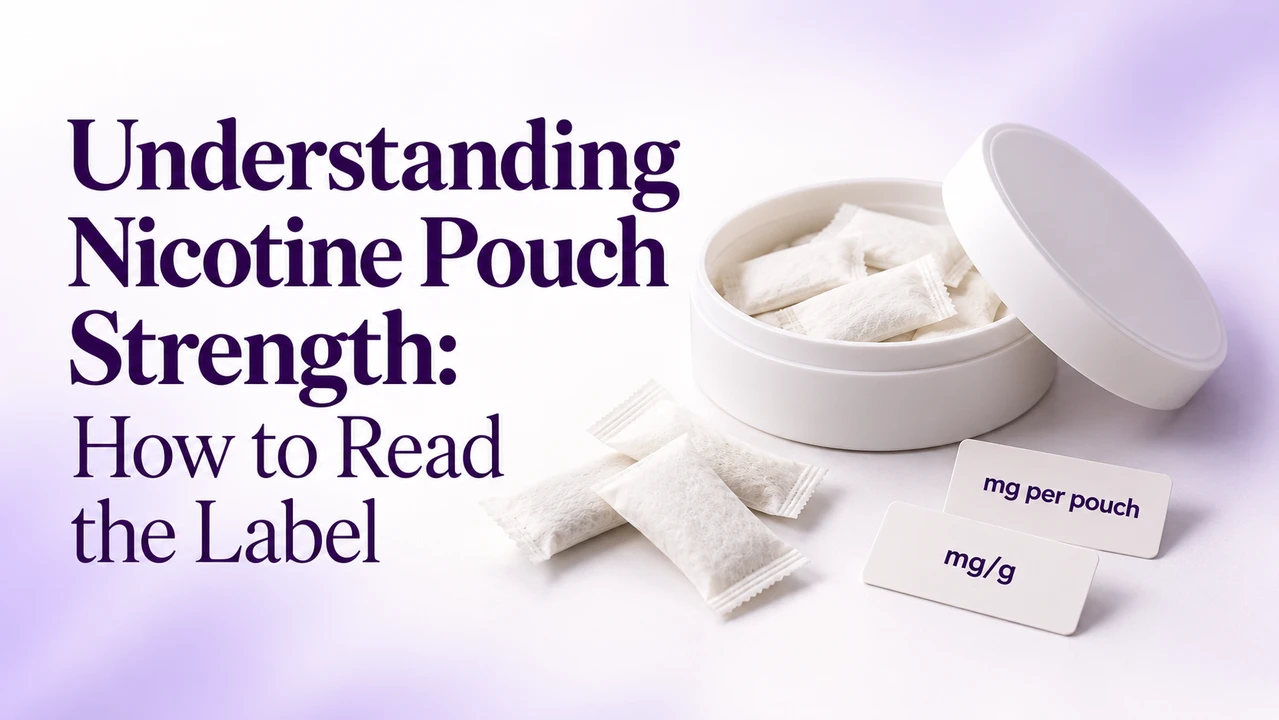
A nicotine pouch labeled “10 mg” might contain less nicotine per pouch than one labeled “6 mg.” How? The first number could mean milligrams per gram, while the second means milligrams per pouch.
That small difference in labeling can make a big difference when comparing products.
For adult nicotine consumers browsing MiPouch, understanding the units is the first step toward making an informed choice. Here’s how to read nicotine pouch strength labels, compare the numbers, and understand why two products with the same labeled nicotine content may feel different.
What Does “mg” Mean on Nicotine Pouches?
Mg stands for milligrams, a unit of weight. On nicotine pouch packaging, it describes an amount of nicotine—but you need to check what that amount refers to.
The two measurements to look for are:
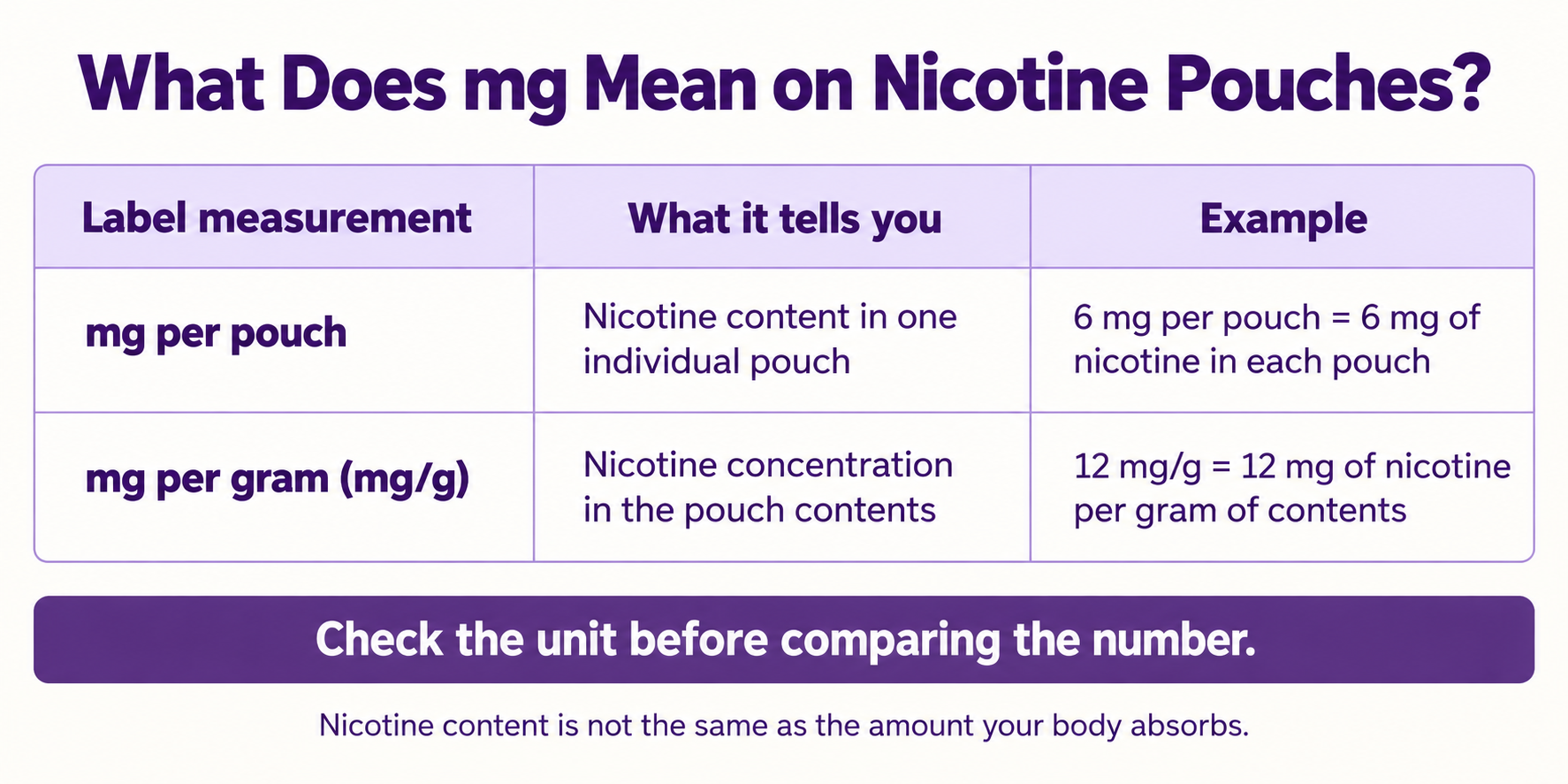
These numbers describe nicotine content. They do not directly tell you how much nicotine your body will absorb during use.
Milligrams Per Pouch: The Most Direct Comparison
When a product specifies mg per pouch, the label gives you the nicotine amount in a single pouch.
For example:
- 3 mg per pouch: Each pouch contains 3 mg of nicotine.
- 6 mg per pouch: Each pouch contains 6 mg of nicotine.
- 9 mg per pouch: Each pouch contains 9 mg of nicotine.
A 6 mg pouch contains twice the nicotine of a 3 mg pouch. That does not mean it will feel exactly twice as strong or produce twice the nicotine exposure.
Product formulation and how the pouch is used also matter.
Milligrams Per Gram: Why Pouch Weight Matters
A label showing mg/g describes concentration rather than the amount in one pouch.
To calculate nicotine content per pouch, you need the weight of the pouch contents:
Nicotine per pouch = nicotine concentration in mg/g × contents weight per pouch in grams
For a hypothetical product labeled 12 mg/g, with 0.5 grams of contents per pouch:
12 mg/g × 0.5 g = 6 mg per pouch
The pouch contains 6 mg of nicotine—not 12 mg.
Example: Comparing Different Label Formats
The following examples are hypothetical and illustrate the math, rather than specific products.
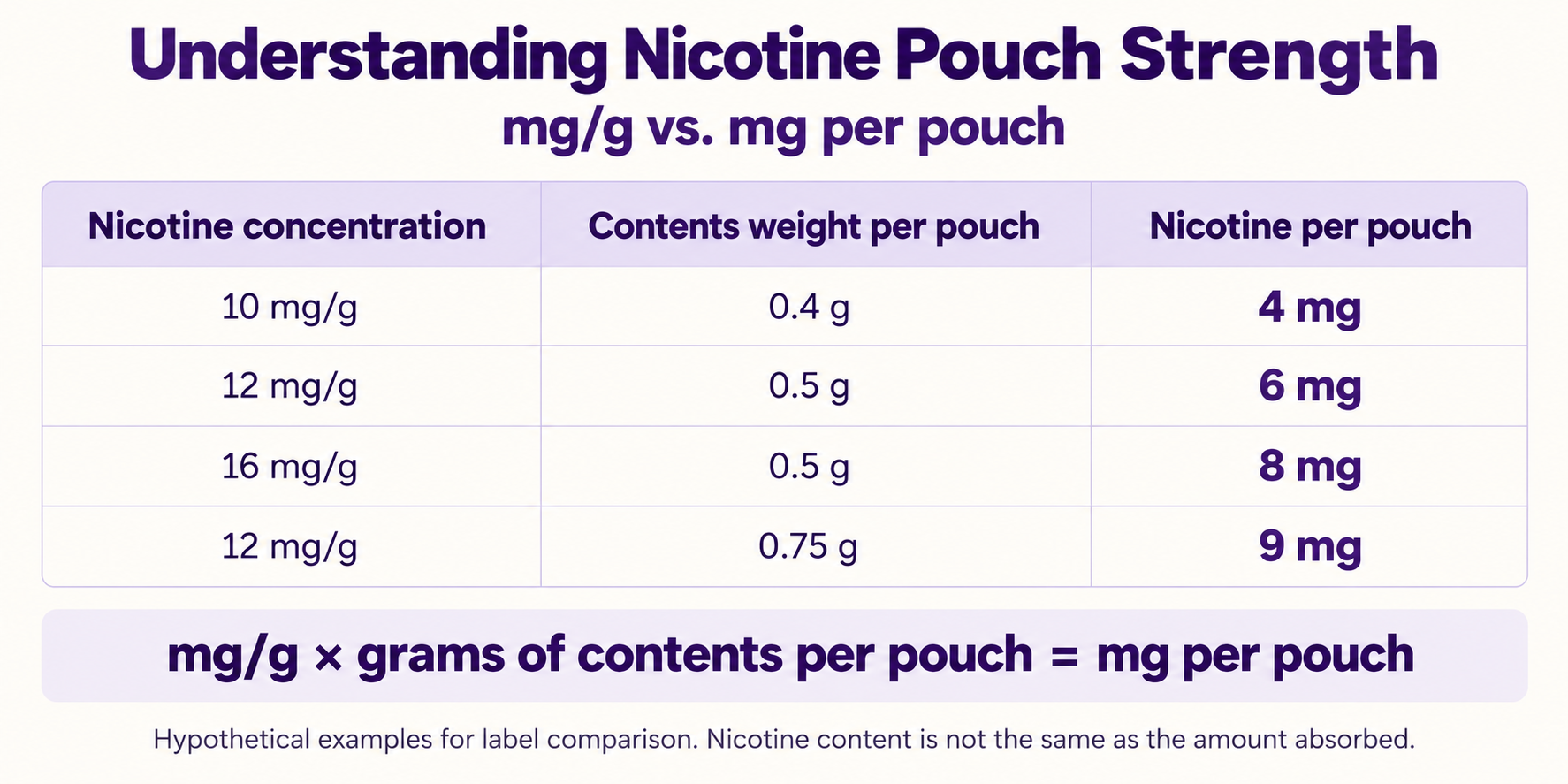
Notice that the two products labeled 12 mg/g contain different amounts per pouch because their pouch contents weigh different amounts.
Compare products using the same unit before deciding which contains more nicotine.
If the manufacturer does not provide enough information to calculate the amount, ask for clarification rather than guessing.
Can You Calculate Pouch Weight From the Tin?
Sometimes the package provides the total net contents weight and the number of pouches.
For example, if a tin contains 10 grams of pouch contents divided among 20 pouches, the average contents weight is:
10 g ÷ 20 = 0.5 g per pouch
If that product is labeled 12 mg/g, the calculated average nicotine content is:
12 mg/g × 0.5 g = 6 mg per pouch
Use this calculation only when the stated net weight corresponds to the contents used for the manufacturer’s nicotine concentration measurement. Do not use the weight of the entire tin and use the manufacturer’s stated mg-per-pouch figure when available.
Why Two 6 mg Pouches Can Feel Different
The nicotine number is useful, but it does not describe everything about the product.
Formulation and Nicotine Release
Pouches differ in their ingredients, moisture, filler, and pouch material. Those differences can affect nicotine release.
A laboratory study examining seven nicotine pouch products found differences in their physical properties and nicotine release profiles. Importantly, laboratory release testing does not directly measure what every consumer will absorb during use.
pH and Nicotine Availability
The acidity or alkalinity of a pouch—its pH—affects the proportion of nicotine present in a form that can more readily cross the lining of the mouth.
Research measuring nicotine pouch chemistry has found substantial differences in pH and free nicotine content between products. This helps explain why total nicotine content alone cannot fully describe nicotine delivery.
Use Time and Individual Differences
How long a pouch stays in place can affect nicotine extraction and exposure. Individual nicotine experience also varies.
There is no single absorption percentage that consumers should apply to every pouch. A labeled 6 mg pouch should not be read as a guarantee that exactly 6 mg enters the bloodstream.
The practical point: matching the number on the tin does not guarantee an identical experience across brands.
What Do Strength Dots and “Extra Strong” Mean?
Some brands use filled dots, numbered levels or descriptions such as “strong” and “extra strong” to help distinguish products within their range.
Those indicators need to be read alongside the actual nicotine amount. For example, ZYN’s UK strength guide pairs its dot system with specific milligram amounts and pouch formats.
For cross-brand comparisons, check out the manufacturer’s explanation of its scale. Do not assume three dots on one brand represent the same nicotine content as three dots on another.
The same applies to terms such as:
- Strong
- Extra strong
- Maximum
- Regular
Treat those descriptions as a starting point. The stated mg per pouch gives you a clearer nicotine-content comparison.
Does a Larger Pouch Always Contain More Nicotine?
No. Pouch size and nicotine content are separate details.
A larger pouch can contain more filling without containing more nicotine. A smaller pouch can contain a higher nicotine concentration.
Terms such as mini, slim, and XL describe the pouch format. Check the nicotine amount separately rather than using size as a shortcut for strength.
Can You Compare Pouch Strength With Vape Strength?
Not directly.
Vape liquid commonly uses mg/mL, which describes nicotine concentration per milliliter of liquid. Pouches may use mg per pouch or mg/g.
These are different measurements for different delivery formats. A 6 mg pouch is not directly equivalent to 6 mg/mL e-liquid, and neither number alone establishes an equivalent amount absorbed.
For the same reason, avoid treating a pouch labeled nicotine content as a precise number of cigarettes.
A Quick Checklist Before Choosing a Pouch
When comparing nicotine pouches at MiPouch:
- Check the unit. Is the number per pouch or per gram?
- Compare like with like. Convert mg/g to mg per pouch only when the necessary weight information is available.
- Read beyond the strength name. Check the actual nicotine content instead of relying on dots or “extra strong.”
- Check the format. Pouch size, moisture and formulation add context.
- Follow the product directions. Do not assume instructions are identical across brands.
Nicotine is addictive. These products are for adults 21 and older who already use nicotine; people who do not use nicotine should not start.
Read the Unit Before the Number
Understanding nicotine pouch strength starts with one question: milligrams of nicotine per what?
Mg per pouch tells you the nicotine content of one pouch. Mg/g tells you its concentration and requires the contents of weight to calculate an amount per pouch.
Once those measurements match, you can make a more useful comparison—while remembering that formulation, use and individual response also shape the experience.
Understanding the label makes comparing nicotine pouches easier. Check the nicotine amount per pouch, look beyond strength dots and consider the pouch format when exploring your options. Shop all nicotine pouches at MiPouch to compare brands, flavors and strengths in one place.
Advice & articles
-

Understanding Nicotine Pouch Strength: How to Read the Label
Oct 23rd 2026A nicotine pouch labeled “10 mg” might contain less nicotine per pouch than one labeled “6 mg.” How?
-

MiPouch Nicotine Pouch Guide
Oct 17th 2026Mi-Pouch Nicotine Pouch Guide Everything You Need to Know About Nicotine Pouches The definitive gui
-

Nicotine Pouch FAQs
Oct 16th 2026Shop Popular Nicotine Pouch Brands Alp Pouches Ammo Juice Head Lucy Breakers Lucy Slim NOAT Sesh+ Zi
- Read more articles